Skip to content
Travelers' Tales Logo
  • HOME
  • BOOKSTORE
  • BOOKS
    • Adventure
    • Classics
    • Family Travel
    • Footsteps
    • Gift Books
    • Humor
    • Spirituality
    • Travel Advice
    • Travel Guides
    • Women’s Travel
  • STORIES
    • Editors’ Choice
    • Larry’s Corner
    • James’s Corner
  • GUIDELINES
    • Submission Guidelines
  • ABOUT
    • Bios
    • Contact Us

Paris Lost and Found

Paris Lost and Found

$16.99A Memoir of Love

Buy now in the Travelers’ Tales store
Buy this book on Bookshop
Buy this book on Indiebound
Buy this book on Amazon
Buy this book on Libro
By Scott Dominic Carpenter
September 2024
9781609522124 272 pages
  • Description

  • Introduction

  • Table of Contents

  • Sample Chapter

  • About the Author

  • Description

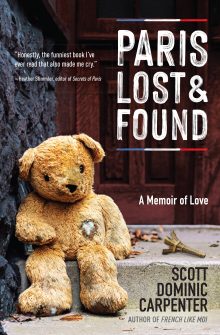
Following his hilarious introduction to Paris in French Like Moi, Midwesterner Scott Dominic Carpenter returns to the scene of the crime with more tales of intrigue.

This time, though, the story starts with sorrow as Carpenter’s wife struggles with dementia. Humor may be the best medicine, but even the antics of a vandal in their building can’t cement the tiles of her memory for long. Before he expects it, the author finds himself alone in a capital that is also blighted by the pandemic.

It’s against this backdrop that the city comes roaring back to life. From bizarre encounters on the Metro to comical clashes with authority figures, and even a quixotic battle against a flock of migrant parrots, Paris Lost and Found unveils sides of the great city that are as quirky as they are authentic. With his unique blend of wit, insight, and wistfulness, Carpenter charts a path through his new labyrinth of solitude—only to emerge on the other side, squinting into the bright light of hope and new beginnings.

  • Introduction

Praise for Paris Lost and Found

“Lovers of Paris know that Scott Carpenter understands and evokes the authentic city behind the iconic sights and tourist cliches. In this sequel to his delightful, insightful French Like Moi, Carpenter takes us on a deeply personal journey, illuminating with poignant humor the City of Light, and loss, and love.” —Don George, author of The Way of Wanderlust

“Almost all stories set in Paris benefit from the reflected glow of the City of Light. But Carpenter has a unique way of seeing the world around him that elevates even the most mundane encounters of everyday life in the 13th arrondissement with curiosity, tenderness, and humor. He writes with a seemingly effortless lightness that’s deceptively hard to achieve in memoir writing, making the reader laugh out loud, even as he shares his journey navigating the sorrow of his own loss. Honestly, the funniest book I’ve ever read that also made me cry.” —Heather Stimmler, editor of Secrets of Paris

“The best travel book I’ve read all year.” —Gillian Kendall, Perceptive Travel

“Directed by his Midwestern sense of delight, Carpenter adopts the role of an American observer, making keen observations about language and about the fact that human vulnerability makes people more alike than they are different. Still, everyone Carpenter encounters is fair game for an affectionate portrait that speaks to their particular quirks and culture. A nuanced memoir about loss, starting over, and embracing a new home abroad.” —Foreword Clarion Reviews

“Five Stars” —Readers’ Favorite

  • Table of Contents

Part One: The End
1. Souvenir
2. Memory
3. Le Turd
4. A Thing I Saw: Escape Velocity
5. Fake-It-and-Wait
6. ’Tis the Season
7. Grand Finale
8. Lockdown

Part Two: The Middle
9. Ghost Town
10. Adieu
11. Silver Screen
12. French Dough
13. A Thing I Saw: Signs
14. Shot in the Dark
15. Scaredy-Cat
16. Wildlife
17. The Parisite

Part Three: The Beginning
18. A Thing I Saw: Epiphany
19. Swipe Right
20. Lost and Found in Paris

Acknowledgments

Book Club Guide

  • Sample Chapter

Chapter 1: Souvenirs

Hands down my favorite heist ever.

It started innocently enough. I’d been recruited to accompany a tour group in the Dordogne Valley, and my job consisted of giving a few lectures about life in France. The rest of the time, my wife, Anne, and I traipsed along with the herd of three dozen Americans. The local guide was a forty-something woman whose wardrobe still clung to her twenties. Marie-Laure’s long scarf flowed behind her as she steered the group through quaint downtowns filled with replicas of ancient buildings. We tasted walnut oil and examined pots, admired countless churches with banks of stained glass. The tour specialized in the picturesque, and our dark-haired leader knew just what to show Americans. In the coach she whispered to the bus driver about where to pull over for the next photo op, and at the chateau she corralled everyone toward the west tower, the one they had to see. We traveled from postcard to postcard, and I lapped it up with everyone else.

Then came the evening they planted us in front of two hours of folkloric dance, performed by grim-faced locals in knickers and suspenders. The applause was thunderous, and for once people got to call out encore! in the country that invented the term. After the show I chatted with one of the curly-haired dancers. While he sucked on a cigarette, I asked if they performed very often. He glanced around to make sure his boss was out of earshot. “Nah,” he said. He let the smoke stream from his nostrils. “We just do this shit for the tourists.”

I felt like a kid in Disneyland who bumps into Mickey on a cigarette break, the mouse head pulled off.

Something was going on.

“Relax already,” Anne said when I told her about it. “Kick back and enjoy yourself.”

I tried. I went with the group to Lascaux, where we stood in line to stare at a modern reproduction of a prehistoric cave. One afternoon we had a wine tasting. And a cheese tasting. And a chocolate tasting. The weather seemed made to order, the dial locked on pleasantly warm.

Then, in Sarlat, a man in our group wandered off down a side street, and Marie-Laure chased him down like a border collie. What didn’t she want him to see? I couldn’t shake the sense that there was a seam somewhere, the edge of a stage set.

It all came to a head the day they brought us to the goose farm. As we hiked across the field to an outbuilding, I nudged Anne, lifted a foot, and pointed at the sole of my shoe.

“What?” she said.

“See?”

“See what? There’s nothing there.”

I nodded vigorously. “Exactly. A farm with no shit.”

Her eye-roll was interrupted by the arrival of those escorting us into yesteryear. There was a smiling man in pristine overalls, a beret screwed to his head—along with his father, hands knotted, trousers filthy, a sullen and wrinkled representative of tradition. The son, Martin, greeted us and trotted out a few jokes. He winked at Marie-Laure and twirled an imaginary moustache, suggesting an amorous relationship.

“Yoo know ’ow we men are een France!” he quipped. The accent verged on outrageous.

Everyone laughed.

Behind him, the father, who was staring at nothing, went gray in the face. His shoulders rounded even more.

The visit got underway. Step by step we learned how they turned birds into little cans of foie gras, the kind awaiting our arrival in the gift shop. There was all the breeding and brooding, the great out-of-doors, and the free range. Eventually Martin eased into the gruesome part that is hard to sugar-coat, the bit about shoving a funnel into the goose’s gullet and pouring in the grain.

“But non, do not worry,” Martin chuckled as he pantomimed the feeding. “Zee goose, he don’t really mind! He ees a ’ungry bugger, zee goose! He weel take all yoo can geeve!

The laughter turned to guffaws. With jolliness and a few exaggerated shrugs, Martin had turned goose torture into a knee-slapper.

In the background, the silent father, a reluctant extra in this performance, had gone ashen. What wouldn’t he have given to be elsewhere—indeed, anywhere other than here, in front of a gawking audience demanding that saucy Frenchness be enacted before them?

And that’s when the penny dropped. No, it wasn’t just the geese who were being fattened up for slaughter. It was us, the Americans. For the past ten days the tour operator had stuck a funnel in our brains and was pouring in the clichés, gallon after gallon. Like the geese, we didn’t even object. The more they gave us, the more we swallowed. Gluttons for this particular punishment, we were insatiable.

I don’t believe I’ve ever had such a sad realization. Everyone we’d encountered over the past week was complicit in the scam—the vendors, the tour guides, the hoteliers, the waiters, and, indeed, even the victims, who—myself included—wanted nothing more than to be duped and beguiled. We wanted the pretty stuff. Like spoiled kids at the dinner table, we demanded dessert while refusing to eat our vegetables. But because we were kids with credit cards, they gave us what we thought we wanted.

On the ride back to the hotel, I stared blankly out the window as blurred countryside rolled by. Anne tried to buck me up, which somehow made it worse.

All the others climbed off the bus before I could struggle to my feet, and then I stood outside the reception area, a bit dazed, not sure which way to go. Why bother?

Everyone else had dashed off to put away their cameras and their goose paraphernalia before heading out to dinner.

That’s when the first cry erupted from the hotel. It was a woman’s voice, high-pitched and startled. Another woman responded, calling out something in English. A man joined in. Then the footsteps began to thunder. Members of our group were scurrying back and forth in the corridors, thumping on doors, checking on their friends. Were they OK? Had their room been broken into as well?

A heist!

The rest was like a waking dream, the scenes flowing together. Outraged Americans mobbed the front desk. The manager with slicked-back hair literally wrung his hands. Marie-Laure ran this way, then that, flummoxed by this event that hadn’t figured on the itinerary. Finally, a siren sounded, and a little green car screeched to a stop out front, a troupe of gendarmes tumbling out of it.

While we were away, someone had gone through the hotel and ripped the wall safes from the wardrobes in the bedrooms. Wallets had vanished, jewelry, even passports!

How would we pay for our meals? What did we need for insurance? Who knew how to fill out a French police report? What if—and now people started eyeing the staff—it was an inside job?

Just like that, the postcard of our French experience had been ripped asunder.

Anne glanced at me and did a double-take. “What’s up with you?” she said. “You’re beaming.”

She was right. I was imagining the grandpa at the goose farm—how he’d have relished this scene. Life was just too wonderful. Oh, sure, we’d lost a few bucks. There’d be insurance claims to file. But better than any souvenir, we’d finally been granted something real and unreproducible—a genuine memory.

The gendarmes were now frisking the chambermaids, one by one.

Anne began to giggle, covering her mouth. While pandemonium swirled around us, the snorts erupted, her laughter fueling mine, mine turbo-boosting hers.

“Oh my God,” she said, wiping a tear from her cheek. “This is one is for the books. I’m going to remember it forever.”

Yep, I thought, drunk with happiness. Me too. Forever.

That was so many years ago.

Only problem is, forever never lasts as long as you think it will. Back then I didn’t know how time passes. How the future creeps up on you. And how sometimes, when you look over your shoulder at yesteryear, what was supposed to be forever has faded from sight.

  • About the Author

Scott Dominic Carpenter teaches French literature and creative writing at Carleton College (MN). Winner of a Mark Twain House Royal Nonesuch Award (2018), he is the author of French Like Moi: A Midwesterner in Paris (winner of a Next Generation Indie Book Award), This Jealous Earth: Stories, and Theory of Remainders: A Novel (a Kirkus Best Book of 2013), which is currently under option with a major motion picture production company. Carpenter splits his time between St. Paul and Paris.

Scott Dominic Carpenter2026-10-14T14:17:03-07:00

Recent Books

The Best Women’s Travel Writing, Volume 13

AVAILABLE NOW!

Includes stories by Roxane Gay, Susan Orlean, Ann Hood, Faith Adiele, Marcia DeSanctis, and Pier Nirandara

The newest collection in this award-winning series from Travelers’ Tales invites you to join twenty-seven inspiring and thoughtful writers as they traverse the planet, crisscrossing all seven continents and exploring the ways travel can illuminate, heal, inform, and transform a life. The essays probe themes as diverse as the locations, immersing us in experiences of kindness, adventure, nature, friendship, strength, marriage, motherhood, spirituality, the environment, belonging, healing, history, identity, romance, and resilience.

This beautiful and far-ranging collection helps us celebrate an appreciation for other cultures while proving that travel can be a profound gateway to connection, self-awareness, and an expanded worldview. As Lavinia Spalding writes in her introduction, “In times of turmoil and despair, it becomes more vital to pay attention to how much there is live for, and travel for, and stand up for, and the stories in this volume shine light on this.”

In The Best Women’s Travel Writing, Volume 13, you will:

  • Embrace contradictions on the late-night tango floors of Argentina
  • Splash toward a sexual awakening in the depths of a French swimming pool
  • Hike the ups and downs of an active volcano and a marriage in Sicily
  • Learn to surf and face cultural stereotypes in Hawaii
  • Experience a different relationship with grief during Day of the Dead in Mexico
  • Uncover the nuances of hair braiding in Nigeria and Morocco
  • Explore the joys and challenges of motherhood in Qatar’s singing sand dunes
  • …and much more.

Strange Tales of World Travel, Volume 2

“What’s the strangest thing you’ve ever seen or experienced?”

Gina and Scott Gaille have traveled to more than 100 countries, including many off-the-beaten-path places in Africa, South America, and Asia. Wherever they go, they ask this question. Everyone has a story, and some are truly extraordinary.

Strange Tales of World Travel, Volume 2 is the follow-up to the Gailles’ award-winning first volume. Their sequel entertains readers with 50 more thrilling, hilarious, heartbreaking encounters, including:

  • Mr. Centenarian, the 111-year-old who attributes his longevity to drinking and bathing in a magical river
  • Mr. Serengeti, who picked the wrong bush to relieve himself in while on safari
  • The Refugee, who witnessed his friend get shot for begging a soldier to protect his family from approaching rebels
  • Mr. Lucky to Live, who was scalped by an angry baboon

…and many more.

100 Places in Italy Every Woman Should Go – 5th Edition

“Makes me want to pack my bag and follow Van Allen’s alluring suggestions…she reveals an intimacy with Italy and a honed sense of adventure. Andiamo!” —Frances Mayes, author of Under the Tuscan Sun

This fully updated 5th Edition of 100 Places in Italy Every Woman Should Go is packed with new information.

Fifteen years ago, the first edition of this book introduced readers to Susan Van Allen, a fun-loving, savvy traveler who helped them create the Italian trip of their dreams. In this fifth edition she returns to lead a femme-friendly ride up and down the boot, exploring the land where Venus (Vixen Goddess of Love and Beauty) and The Madonna (Nurturing Mother of Compassion) reign side-by-side. Enjoy masterpieces of art that glorify womanly curves, join a cooking class taught by revered grandmas, shop for ceramics and jewelry, ski the Dolomites, hike the Path of the Gods or paint a Venetian mask. Whatever your mood or budget, with this fifth edition of 100 Places in Italy Every Woman Should Go, Italy opens her heart to you.

Paris Lost and Found

Paris Lost and FoundFollowing his hilarious introduction to Paris in French Like Moi, Midwesterner Scott Dominic Carpenter returns to the scene of the crime with more tales of intrigue.

This time, though, the story starts with sorrow as Carpenter’s wife struggles with dementia. Humor may be the best medicine, but even the antics of a vandal in their building can’t cement the tiles of her memory for long. Before he expects it, the author finds himself alone in a capital that is also blighted by the pandemic.

It’s against this backdrop that the city comes roaring back to life. From bizarre encounters on the Metro to comical clashes with authority figures, and even a quixotic battle against a flock of migrant parrots, Paris Lost and Found unveils sides of the great city that are as quirky as they are authentic. With his unique blend of wit, insight, and wistfulness, Carpenter charts a path through his new labyrinth of solitude—only to emerge on the other side, squinting into the bright light of hope and new beginnings.

A Hard Place to Leave

A Hard Place to Leave
Winner of the 2023 Lowell Thomas Award!

Vogue‘s Best Books of 2022

“Intrepid and empathetic, gifted with the dispassionate gaze of a born observer…a harmonious collage of worldview and character, a wunderkammer of experiences in a life fully lived.” —Melissa Febos, The New York Times

Restless to leave, eager to return: this memoir in essays captures the unrelenting pull between the past and the present, between traveling the world and staying home.

Starting in a dreary Moscow hotel room in 1983, weaving back and forth to rural New England, and ending on a West Texas trail in 2020, Marcia DeSanctis tells stories that span the globe and half a lifetime. With intimacy and depth, over quicksand in France, insomnia in Cambodia, up a volcano in Rwanda, spinning through the eye of a snowstorm in Bismarck, and atop a dumpster in her own backyard, this New York Times bestselling author, award-winning essayist and journalist for Vogue and Travel + Leisure immerses us in places waiting to be experienced and some that may be more than we’re up for. She encounters spies, angels, leopards, shoes, the odd rattlesnake, a random head of state, and many times over, the ghosts of her past. Each subsequent voyage leads to revelations about her search for solitude, a capacity for adventure, and always, a longing for home.

The Temporary European

“Vivid, funny, perceptive, intimate, and charged with a love of travel and a deep sense of humanity.” —Rick Steves, from the Foreword


20+ Years as Rick Steves’ Right-Hand Man


A candid account of how the sausage gets made in the travel business—told with affection, warts-and-all honesty, and a sense of humor.


What is it like to write guidebooks, make travel television, and lead bus tours for a living? Find out with Cameron as he samples spleen sandwiches at a Palermo street market, stews in Budapest’s thermal baths, survives driving in Sicily without going insane, and much more. Along the way, he shares many lessons learned from his favorite Europeans. You’ll also get a reality check for what seems to be a traveler’s dream job—working with Rick Steves and his merry band of travelers. Not just for Rick Steves fans but for anyone who loves Europe, The Temporary European is inspiring, insightful, and fun.

La Dolce Vita University – 2nd Edition

Come travel with La Dolce Vita University (L◆D◆V◆U) to the heart of Italian culture in the seductive spirit of la dolce vita. L◆D◆V◆U is the perfect sampler to indulge anyone curious about—or already in amore with—Italy and its remarkably rich trove of cultural treasures. In dozens of entertaining yet authoritative mini-essays, including 60 new stories and 40 new illustrations in this fully updated 2nd edition, L◆D◆V◆U lets you explore, at your leisure, fascinating aspects of Italy’s cuisine, history, art, traditions, style, legendary personalities, and so much more.

The book is organized alphabetically, but nothing is ever quite that straightforward when it comes to Italy. Even if you choose to read these mini-essays sequentially, you may very well feel as though you’re wandering the mysterious alleys of a medieval town, the hidden vicoli of a larger city, or even along the serpentine canals of La Serenissima.

The End of the World Notwithstanding

“Every word the right word, this book is a genuine keeper.” —Kirkus Reviews***Starred Review***

Rife with misadventure, brushes with death, and moments of existential insight, The End of the World Notwithstanding is a hilarious and reflective look at the emotional experiences that make everyday life exciting—and the physical ones that remind us we’re lucky to be alive. These nail-biting stories, all true, fill the reader with wonder, as in, “How do any of us survive?”

Encounters with wildfire, hideous insects, psychotic house pets, bad weather, gravity, predators, bullies, and the most potent force of all—fear—unfold in remote landscapes of the American West; on neon-splashed Hollywood sidewalks; in a Catskills summer camp for actors; in the Boston apartment of a famous senator; on a cliff high above the Mediterranean; beneath the streets of Paris. Goodwin looks for and finds meaning, if not security, in a clear-eyed acknowledgment of the human condition—and in the saving grace of laughter.

The Best Women’s Travel Writing, Volume 12

As Andrew McCarthy wrote in The New York Times Book Review, “For more than 20 years, Travelers’ Tales has been publishing books that might best be described as the literary equivalent of a group of travelers sitting around a dim café, sipping pints or prosecco and trading their best stories.”

Now comes The Best Women’s Travel Writing, Volume 12: True Stories from Around the World—the latest collection in the best-selling, award-winning series that invites you to ride shotgun alongside intrepid female nomads as they wander the globe discovering new places, faces, and facets of themselves.

“In story after story,” McCarthy wrote about the previous volume of The Best Women’s Travel Writing, “the refreshing absence of bluster and bravado, coupled with the optimism necessary for bold travel, create a unifying narrative that testifies to the personal value and cultural import of leaving the perceived safety of home and setting out into the wider world.”

The essays in this volume are as diverse as the destinations, exploring themes of kindness, transformation, nature, friendship, family, strength, and resilience.

French Like Moi

“I laughed until my sides hurt at Carpenter’s lighthearted and self-deprecating take on living in l’Hexagone.” —Kimberley Lovato, author of Walnut Wine & Truffle Groves

When Scott Carpenter moves from Minnesota to Paris, little does he suspect the dramas that await: scheming neighbors, police denunciations, surly demonstrators, cooking disasters, medical mishaps—not to mention all those lectures about cheese! It turns out that nothing in the City of Light can be taken for granted, where even trips to the grocery store lead to adventure.

Everything is grist for Carpenter’s mill. In eighteen tales, he lifts the curtain on what passes for normal in Europe’s most glorious capital: neighbors who plot to murder one another, hiccups in transportation, bizarre store exchange policies, operatic dramas in the condo association, healthcare à la française, underground labyrinths, and even terrorism. In the company of a cast of recurring characters, he leads us through the merry labyrinth of the everyday, one hilarious faux pas after another. Through it all, Carpenter, winner of Mark Twain House Royal Nonesuch Prize for humor, keeps his eye on the central mystery of what makes the French French (and Midwesterners Midwestern).

Copyright 2025 Travelers' Tales | All Rights Reserved
FacebookX
Page load link